
Porter Health
The Female Life Stage Framework
Four stages, defined by hormones rather than birthdays, each a window for preventing heart disease
Key Takeaways
- Heart disease is the leading cause of death in women, and the risk changes with each hormonal transition, not just with age.
- The American Heart Association, pediatricians, obstetricians and maternal-fetal medicine specialists agreed in 2026 on four stages, with pregnancy as a stress test that can occur in any of the first three, and after menopause only through assisted reproduction.
- Your stage is read from your profile (menopause status, age, and whether you are pregnant), and it shapes which questions we ask and determines actions in your plan.
- Perimenopause is the prevention window: changes made then do more than the same effort a decade later.
The four stages
The stages follow the hormonal changes women go through, and your doctor can tell which one you are in from your periods and your symptoms. Hormone blood tests are not needed; they vary so much from week to week that they are rarely helpful for this. The ages are a rough guide. Plenty of women reach a stage earlier or later.
Stage 1: Perimenarche
Usually ages about 8 to 15
The years around the first period, while cycles settle.
A first period before 10 is a risk enhancer later in life, and the habits formed now shape lifelong heart health.
Stage 2: Ovarian cycling
Usually ages about 15 to 44
Regular ovulatory cycles; the years when pregnancy can occur.
Cycling hormones protect the blood vessels, so risk is usually low. Irregular cycles, PMOS (formerly PCOS), heavy periods and the method of contraception all carry heart implications, and anything a pregnancy reveals counts for decades.
Stage 3: Perimenopause
Usually ages about 45 to 51
Cycles vary by a week or more, hormones swing, and menopause symptoms often begin.
LDL cholesterol and Lp(a) rise with the transition independent of age, with vascular stiffening, belly fat and insulin resistance. Frequent or severe hot flashes and poor sleep are linked to higher risk. This is the prevention window.
Stage 4: Postmenopause
Usually ages 51 and older
Twelve months after the final period; estrogen is low and stays low.
Risk rises faster and most first heart events in women happen here, so prevention is treated by the same standard as for a man of the same age. Hormone therapy is for symptoms, never for heart protection.
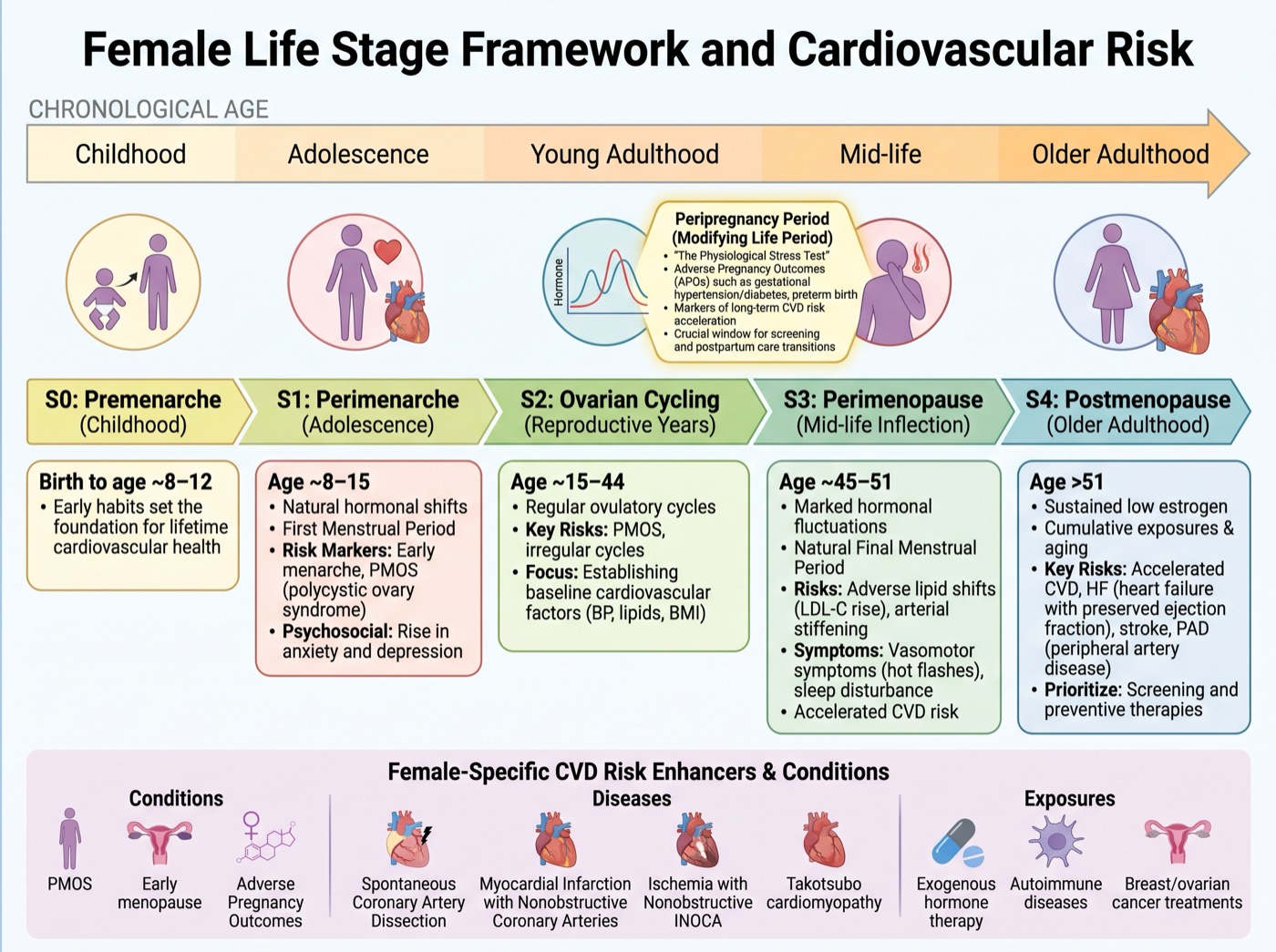
Pregnancy, in any stage before menopause
Pregnancy can occur in the first three stages, and after menopause only with assisted reproduction. It raises estrogen thirty-fold and asks the heart, blood vessels and kidneys to adapt. Problems that surface then, such as high blood pressure, preeclampsia, gestational diabetes or an early delivery, are now counted as cardiovascular risk enhancers for the rest of life. The year before a pregnancy and the year after are both chances to act: most pregnancy complications track the blood pressure, blood sugar and weight a woman brings into pregnancy, and the first year after delivery is when follow-up is most often lost.
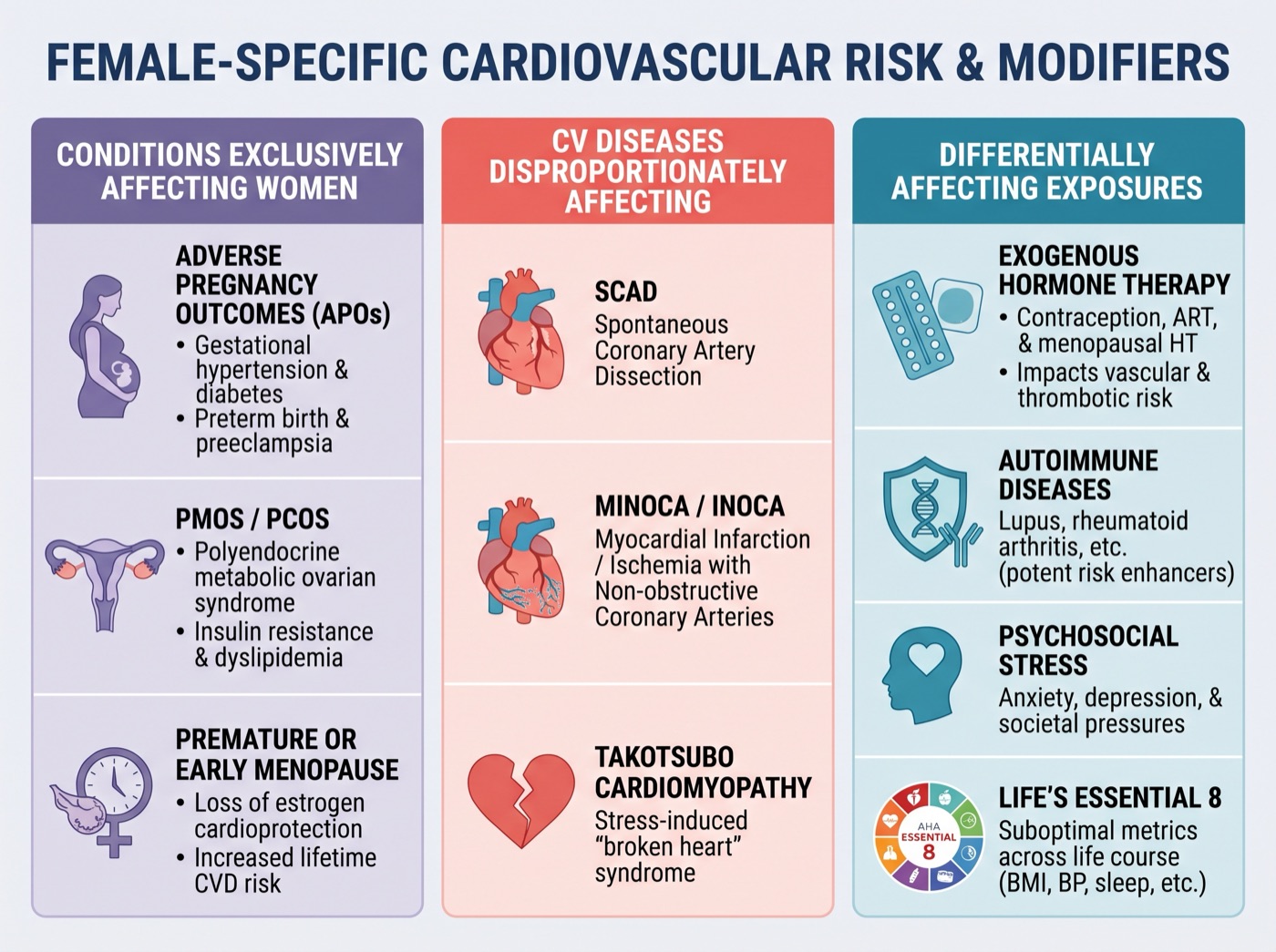
What is different for women
Three groups of things set women's heart risk apart. Some conditions happen only to women: pregnancy complications, PMOS (formerly PCOS), and an early or premature menopause. Some heart diseases hit women far more often: a tear in a coronary artery (SCAD), heart attacks with open arteries (MINOCA and INOCA), stress-induced “broken heart” syndrome (Takotsubo), and heart failure with a preserved ejection fraction. And some exposures land differently in women: hormone therapy (the route matters; skin patches carry less clotting risk than oral estrogen), autoimmune diseases (more than 80% of cases are in women), and the way stress, sleep and mood feed into metabolic health.
What Porter Health does with your stage
Shows it
Your stage sits on My Scores and My Data, with a line on what your plan is watching right now.
Asks less
You only see the women's health questions that fit your stage: pregnancy plans and contraception before 50, the cause of menopause after an early one, and so on.
Counts what matters
A first period before 10, irregular cycles, PMOS, pregnancy complications and an early or surgical menopause all count toward your prevention plan, as the 2026 guidelines ask.
Guides treatment
In perimenopause and after, your plan follows the 2026 guidance on menopause symptoms, including when nonhormonal options come first.
Your stage comes from the Women's Health section of your profile. Keep that current and your plan stays current.